
How to Tell if a Tree Is Dangerous Before It Falls:
8 Warning Signs Homeowners Should Know
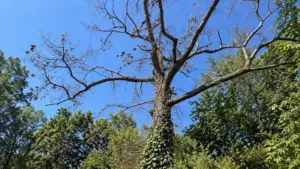
A large, mature tree can be one of the most valuable features of a property. It provides shade, beauty, wildlife habitat, and character that can take decades to replace.
But when a tree develops structural problems, it can also become a concern—especially when it is close to a house, driveway, road, play area, or other place where people spend time.
Knowing how to tell if a tree is dangerous can help you spot potential problems before a branch—or the entire tree—fails. The difficult part is that hazardous trees don’t always look obviously dangerous. At the same time, some things that look alarming to a homeowner don’t necessarily mean a tree needs to be removed.
Here are eight warning signs worth paying attention to.
1. Large Dead Branches
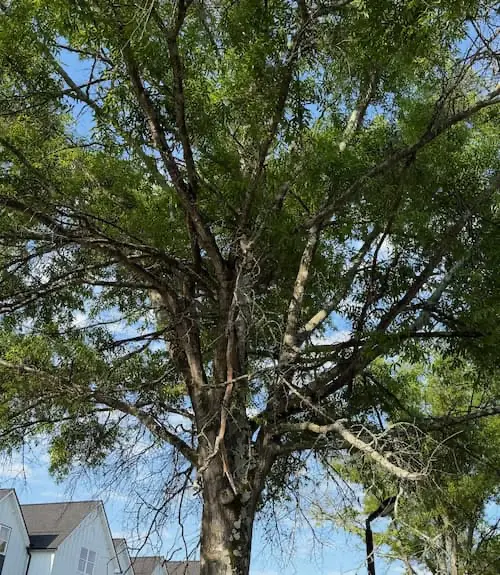
A few small dead twigs aren’t usually cause for alarm. Large dead limbs are a different matter.
Once a branch dies, the wood gradually loses strength. Eventually, the branch may break away from the tree. This is especially concerning when dead limbs extend over a house, driveway, sidewalk, patio, or other frequently used area.
Look for branches that have no leaves during the growing season, peeling or missing bark, visible decay, or numerous smaller dead twigs.
Dead branches don’t automatically mean the entire tree is unhealthy or needs to be removed. In many cases, proper pruning can address the immediate concern while preserving the tree.
2. Cracks or Splits in the Trunk or Major Limbs
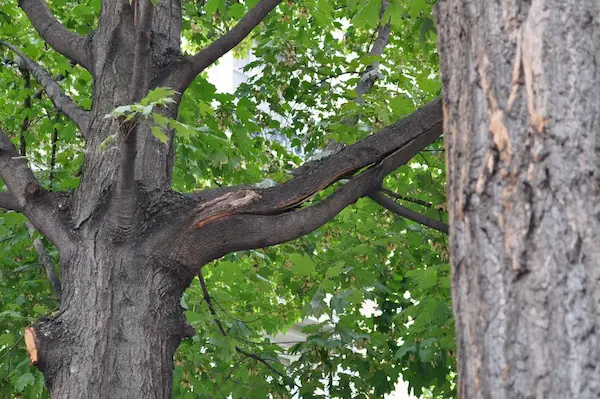
Trees routinely withstand considerable forces from wind, rain, and the weight of their own branches. Cracks can indicate that part of the tree’s structure is beginning to fail under those forces.
Pay particular attention to deep cracks in the main trunk, splits where two large stems meet, or cracks extending through a major branch.
Some cracks remain relatively stable for years, while others can represent a significant structural weakness. Their location, depth, and surrounding wood all matter.
This is one situation where appearances alone don’t always tell the whole story.
3. Cavities or Areas of Decay
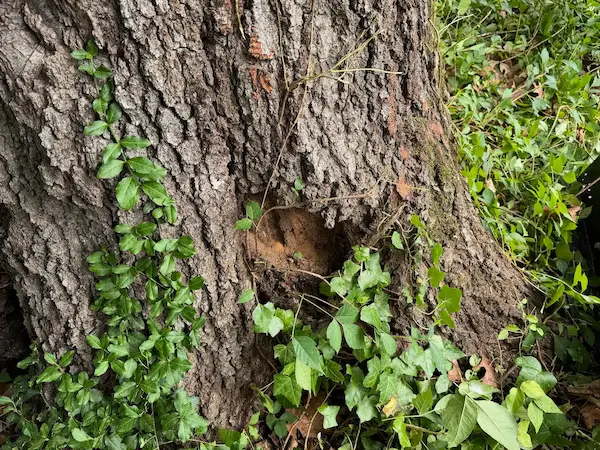
Holes and cavities commonly develop in older trees, particularly after branches break or previous injuries allow decay to enter the wood.
A hollow tree is not automatically a dangerous tree. Trees can sometimes remain standing for years with internal cavities because living wood continues growing around the outside of the trunk.
The important question is how much sound wood remains and where the decay is located. A cavity near a major structural junction, for example, may have different implications than a similar cavity elsewhere.
If you notice a large cavity, soft or crumbling wood, or an area that appears extensively decayed, it may not need to be removed, but it is important to have it evaluated to determine the extent of the hazard.
4. Significant Changes in the Canopy
The canopy often provides early clues that something is affecting a tree.
Watch for changes such as unusually sparse foliage, leaves that are significantly smaller than normal, large sections of dead branches, premature leaf drop, or one portion of the canopy declining while the rest remains healthy.
These symptoms don’t necessarily indicate that a tree is structurally unsafe. They can result from summer fatigue, drought, root problems, insects, disease, soil conditions, or other environmental stresses.
But a major or unexplained change in the canopy is worth investigating—particularly in a large mature tree. Finding the underlying problem early may provide more options for preserving the tree.
5. Mushrooms or Fungal Growth Around the Tree
Mushrooms growing on or near a tree can sometimes provide clues about what is happening beneath the surface.
Fungal growth on a tree trunk is a positive indicator of rot. Certain fungi growing directly from the trunk, root flare, or major roots can indicate internal decay that isn’t otherwise visible.
However, mushrooms in the lawn near a tree aren’t necessarily evidence that the tree is unhealthy. Many harmless fungi live in soil and in decomposing organic material. In fact, fungus in the root zone is extremely beneficial to a trees health, so fingicides should not be applied broadly.
The type and location of the fungal growth are important.
If mushrooms repeatedly appear directly from the trunk or base of a large tree, particularly one near a structure, having them identified and the tree examined is a sensible precaution.
6. A Tree That Has Recently Started Leaning
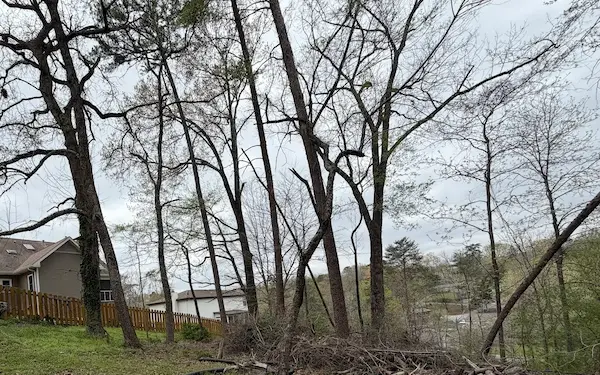
Plenty of healthy trees grow at an angle. A tree that has leaned for decades isn’t necessarily unstable simply because it isn’t perfectly vertical.
A new or increasing lean is more concerning.
Watch for changes such as:
- A tree that appears to be leaning more than it did previously
- Soil lifting or cracking on one side of the trunk
- Exposed or broken roots
- A newly formed gap between the soil and the base of the tree
These signs can indicate movement of the root system.
Changes after heavy rain or strong winds deserve particular attention. Saturated soil can cause structural movements, reducing the support available to roots and greatly reducing structural integrity. Wind places additional force on the canopy.
7. Root Damage or Problems Around the Base
A tree’s roots are both its support system and an essential part of its ability to obtain water and nutrients.
Unfortunately, significant root damage can be difficult to see.
Construction, trenching, changes in soil grade, vehicle traffic, soil compaction, and cutting large roots can all affect a tree. Decay can also develop in the roots or at the base of the trunk.
Visible warning signs may include damaged roots, decay near the root flare, unusual movement of the tree, or a noticeable decline in the canopy following construction or excavation.
Changes made around a tree years earlier can sometimes contribute to problems that only become apparent later.
8. Damage After a Storm
Strong thunderstorms can place enormous stress on mature trees.
After severe weather, inspect trees around your home for broken or hanging limbs, fresh cracks, split branch unions, newly exposed roots, changes in lean, or branches that have become lodged in the canopy.
Some storm damage is obvious. Other damage can be difficult to see from the ground. A branch may crack without completely separating, for example, leaving a heavy limb suspended overhead.
Never stand underneath a damaged tree or attempt to pull down a large hanging branch yourself. Broken limbs can move unexpectedly, and damaged trees can behave very differently from intact ones.
Monitoring trees after a storm is imperative. An inspection by an arborist may very well mean the difference between prevention and tree failure.
Does One Warning Sign Mean the Tree Needs to Come Down?
Usually, no. Tree risk isn’t determined by a single symptom.
An arborist considers the tree’s species, size, condition, structure, root system, defects, surrounding environment, and—importantly—what would be affected if part or all of the tree failed.
A declining tree in an isolated part of a large property presents a very different situation from the same tree directly over a bedroom or heavily traveled driveway.
In some cases, pruning can reduce risk. Other trees may benefit from monitoring or treatment. And sometimes removal really is the appropriate option. Learn more in our guide to when you should remove a tree.
The goal should be to understand the condition of the tree before deciding what to do with it.
Don't Wait for a Tree to Look Obviously Dangerous
One of the advantages of periodically looking at the trees on your property is establishing what is normal for them.
When you know how a tree usually looks, you’re more likely to notice a new lean, declining branch, crack, fungal growth, or other change.
This is particularly worthwhile for large mature trees near homes and other areas where a failure could cause significant damage.
Trees are living structures, and their condition changes over time. Catching a developing problem early can sometimes mean the difference between relatively simple corrective pruning or treatment and dealing with a much larger and more expensive problem later.
Concerned About a Tree on Your Chattanooga-Area Property?
If you’ve noticed something unusual about one of your trees and aren’t sure what it means, ArborTech Tree Services can help evaluate it.
With an ISA Certified Arborist on staff, ArborTech can assess the tree’s health and structure and help determine whether pruning, tree health care, continued monitoring, or removal is appropriate. We serve homeowners throughout the Chattanooga area and offer free estimates for tree service work.
Here’s a brief article from the International Society of Arboriculture (ISA) on why to hire an arborist.
For homeowners who want to take a more proactive approach, we also offer Tree Health Memberships—a cost-effective way to have your trees inspected and monitored regularly. This identifies developing problems early and helps prevent small issues from becoming more serious and expensive ones.
The objective isn’t simply to remove trees. It’s to understand what’s happening with the tree, preserve healthy trees whenever practical, and recommend an appropriate course of action.
ArborTech Tree Services, LLC
Professional tree care for Chattanooga and surrounding communities.
